

Eternal Echoes
The Enduring Ripples of Mythistory (Part 1)

Mythistory: I’m not the first to use this term, but I like it. It summons ideas that my humble Substack posts have always striven to take. A path that lays in the tracts of undefined territory that reside between myth and history, where echoes of the remote past ripple through time. They resonate through our history, mine and yours. So, here we go, this week I’m trying something a little different…
It is refreshingly cool within the darkness of these woods. The multilayered ceiling above is supported by shadowed boughs, their elephantine legs mottled by subdued spills of light. All is quite there, but you can feel that it is full of life, and therefore energy; ripening, working, waiting. To my mind this is the true temple, the best church, spanned with a luxuriant expanse of emerald.
Outside the sky is cloudless, hot and we are still gripped by this heatwave. Less so in Scotland than down South… but it’s still hot. We still feel it.
I am following snaking trails through Corncockle quarry. A place that I have returned to time and time again. In autumn the woods dampen, the moist ground yields numerous forms of fungi, camouflaged amongst the layers of fallen leaves. Some are edible, others less so. In winter the skeletal trees are far removed from the days of summer. Stripped of their finery they become haunted visages crouched beneath leaden skies.
Not far from where I stand is the quarry hole, a rupture in the earth, a wound of dark, reddish orange. It is a place that I recall visiting many times in the late 1980s. I was fascinated by the stacks of cars and lorries that girded the lip of the hole spilling down its sides into the orange waters below. After it fell into disuse in the early 1900s the quarry hole became an unofficial dumping ground, forming a decaying time-capsule of wrecks, baring the styles of the fifties, sixties and seventies. At some point in the late 90s or early 2000s the quarry started up again and the wrecks were removed. Now the site is disused once more and, apart from the hole, most of the quarry fell under Nature’s sway many decades ago. The hole is surrounded on three sides by slender firs and birch, rowans huddle beneath the tall trunks, bedded across the serried ranks of quarry terraces.


The old red sandstone forms part of a number of strata evident in parts of Scotland. Sandstone can be seen at Rosslyn Glen and at Mauchlinne, where, hidden in the trees, Bronze Age people carved their mysterious designs upon the vertical walls.
Hardened under the pressure of millennia, in Southwest Scotland these layers comprise of two types: New Red Triassic Sandstone being formed in water, and New Red Permian Sandstone formed in drier desert conditions. Corncockle is of the latter type, and while quarriers whittled away at red humps of sandstone in the region, Corncockle has a long history. Perhaps the quarry’s biggest claim to fame comes from the footprints that were found there in 1824. Scientists of the times then believed the Permian era devoid of life. But workmen at Corncockle had long found sets of regular tracks in some layers of the stone. The Rev Henry Duncan studied many of the prints and concluded that they belonged to some distant relative of the tortoise. Life crawled across the blank pages of geology, life whose passage had been captured after rain formed a patina of claggy clay, which had dried and was then covered in dry sand. Some of the trails were extensive and angled at about 40 degrees, suggesting to the geologists of the time that the creatures had been navigating sand dunes.
Such was the magnitude of the find that parties of Victorian naturalists flocked to Corncockle Muir in horse-drawn carriages. The quarry provided a point of interest on excursions that included Spedlins Tower and other local sites. One such outing, in 1884, reported that the forestry plantation there had been all but destroyed by the previous winter’s harsh storms, with most of the firs uprooted or snapped in the middle. The woody ancestors of this plantation still exist as managed woodland and the hedges of beech that survived those Victorian storms are now grand trees.
As I stand there, gazing down the steep embankments, glimpsing the raw sandstone of what remains of the quarry hole, I feel a sense of the rush of days, years, decades and millennia. Beneath the trees the dark red stone waits. This quarried earth, mauled by Victorian quarriers, has an extensive and venerable past. It is said that stone from the quarry was used at Lochmaben Castle, whose remains sit on the banks of Castle Loch. Polished red stone was used to flank its walls when it was built in the 1300s.
However the quarry truly flourished in the 1800s, and its stone was famed across the land. Blocks of Corncockle red found their way to sites such as Edinburgh’s Caledonian Hotel, Glasgow’s Kelvin Hall and blocks were shipped across the Atlantic where they furnished a famous department store known as Morgans of Montreal. The building still exists to this day and survived, albeit under different companies, until early 2026 when it went into receivership. The fate of the building is yet to be decided.
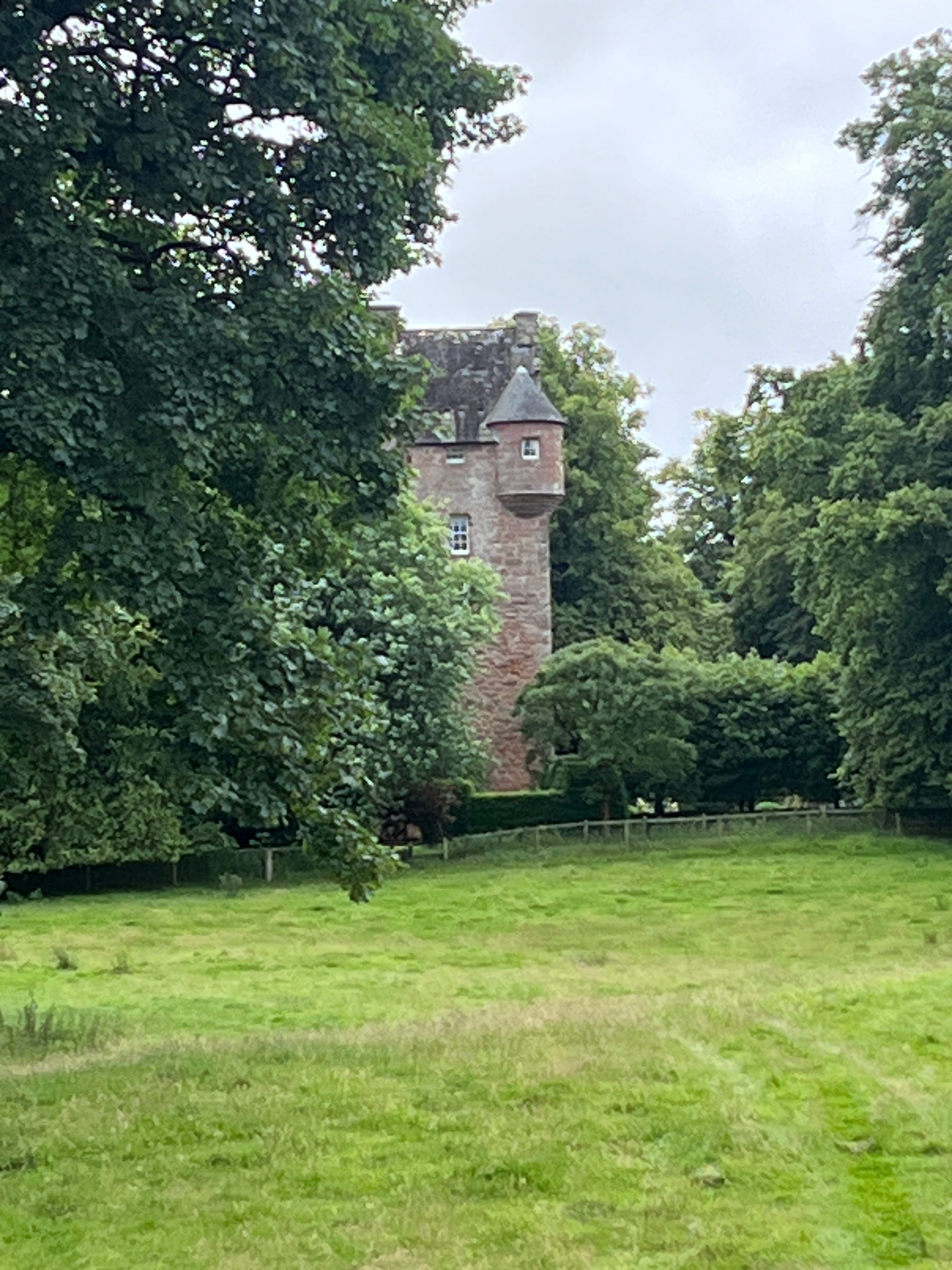
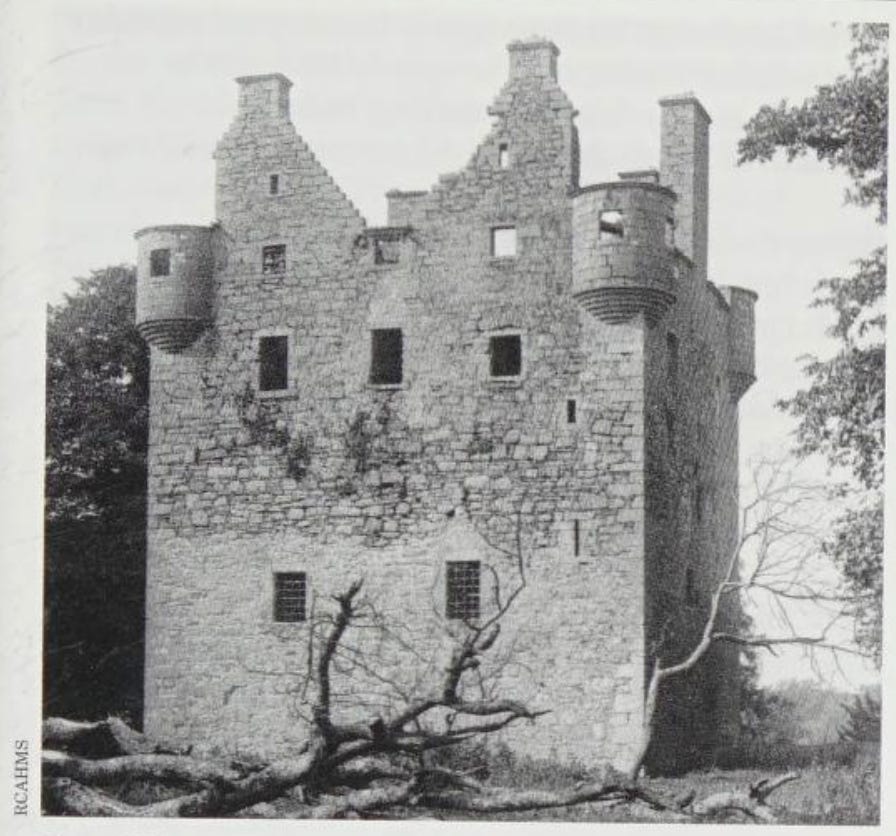
A stone’s throw from Corncockle Quarry sits another beneficiary of its medieval diggings. Spedlins Tower snuggles amongst deciduous cover near the banks of the River Annan. Also forming part of the Jardine estate of Applegarth (of which Corncockle is also part), the tower is a solid looking 15th century border keep, typical of those found in the region. It has been restored and houses wealthy guests these days (from a mere £1,000 per night). But the tower’s most famous ‘guest’ was Porteous, known locally as Dunty Spedlin.
The story goes that Porteous was a miller who earned the displeasure of the laird. Imprisoned in a dark dungeon hole in the tower, he was left there when the laird split for Edinburgh on business (when the laird went so too the household retinue). Dunty was left to starve – in the local version it’s said he was chained to the wall and tried to eat thought his hands to escape. Afterwards Porteous’ ghost haunted the castle until a priest was summoned to help drive the sprite away. A traditional ballad fleshes out the details:
THE PRISONER OF SPEDLINS
To Edinburgh, to Edinburgh,
The Jardine he maun ride;
He locks the gates behind him,
For lang he means to bide.
And he, nor any of his train,
While minding thus to flit,
Thinks of the weary prisoner,
Deep in the castle pit.
They were not gane a day, a day,
A day but barely four,
When neighbours spake of dismal cries
Were heard from Spedlins Tower.
They mingled wi’ the sighs of trees,
And the thud-thud o’ the lin;
But nae ane thocht ’twas a deein’ man
That made that eldrich din.
At last they mind the gipsy loon,
In dungeon lay unfed;
But ere the castle key was got
The gipsy loon was dead.
They found the wretch stretch’d out at length
Upon the cold, cold stone,
With starting eyes and hollow cheek,
And arms peeled to tha bone!
Now Spedlins is an eerie house,
For oft at mirk midnight
The wail of Porteous’ starving cry
Fills a’ that house wi’ fright.
“O let me out, O let me out,
Sharp hunger cuts me sore;
If ye suffer me to perish so,
I’ll haunt you evermore!’’
O sad, sad was the Jardine then,
His heart was sorely smit;
Till he could wish himself had been
Left in that deadly pit.
But ‘‘ Cheer up,’’ cried his lady fair,
“Tis purpose makes the sin,
And where the heart has had no part
God holds His creature clean.’’
Then Jardine sought a holy man
To lay that vexing sprite;
And for a week that holy man
Was praying day and night.
And all that time in Spedlins house
Was held a solemn fast,
Till the cries waxed low, and the boglebo
in the deep Red Sea was cast
There lies a Bible in Spedlins ha’,
And while it there shall lie
Nae Jardine can tormented be
With Porteous’ starving cry-
But Applegarth’s an altered man
— He is no longer gay;
‘The thought of Porteous clings tae him
Until his dying day.
References:
Transactions & journal of the proceedings of the Dumfriesshire & Galloway Natural History & Antiquarian Society 1907,
Transactions & journal of the proceedings of the Dumfriesshire & Galloway Natural History & Antiquarian Society 1884
History of Montreal: including the streets of Montreal, their origin and history 1897
by Borthwick, J. Douglas (John Douglas), 1832-1912
The Ichnology of Annandale – Sir William Jardine (1907)
Transactions of the RSE, 1827 – H. Duncan
Sandstone Heritage of Dumfriesshire – Jame Irving Hawkins
Dumfries & Galloway: an Illustrated Architectural Guide – John R. Hume (top Image of Spedlins)
Great! My new term, mythistory.
What a great story Dave, I particularly like the way you describe the landscape, through a true stone carvers eye.