

In Labyrinths Dreaming
Stumbling Deeper into the Maze

In my wayward youth I sometimes immersed myself in the works of William S. Burroughs – both his spoken word and actual writings. Books like Naked Lunch and the Soft Machine really opened up my teen-age mind, tugging me from the cozy harbours of fantasy fiction et al*. The books of his that stayed with me most were the Cities of the Red Night trilogy. Using his menagerie style to its fullest, he created a sort of weird dreamscape set in labyrinthine cities which equated to the Egyptian realm of the dead, the Duat.
We can argue how the Duat was visualised by the ancients. Ancient texts such as The Book of Gates, or Book of Caverns suggest a series of doorways and pylons through which the dead travel. Most commonly it is said to be divided by twelve gates, each guarded by a deity. The gates each represent an hour of the nightly cycle, which was so bound into the imagery of death and rebirth of the sun. In the Book of the Dead spells are given to aid the dead pass through each gateway. The spells were meant to be memorised and chanted by the deceased as they travelled through this underworld realm. In original form The Book of the Dead is a series of texts painted on papyrus. Its proper name is translated as Spells of Coming Forth by Day. It was begun in about 1550 BC and added to by various priests as late as 50 BC. Some of the spells bore their origins in much older texts dating to the third millennium BC. Sometimes sections of the Book were painted onto the coffins of the dead and incorporated into elaborate illustrations.
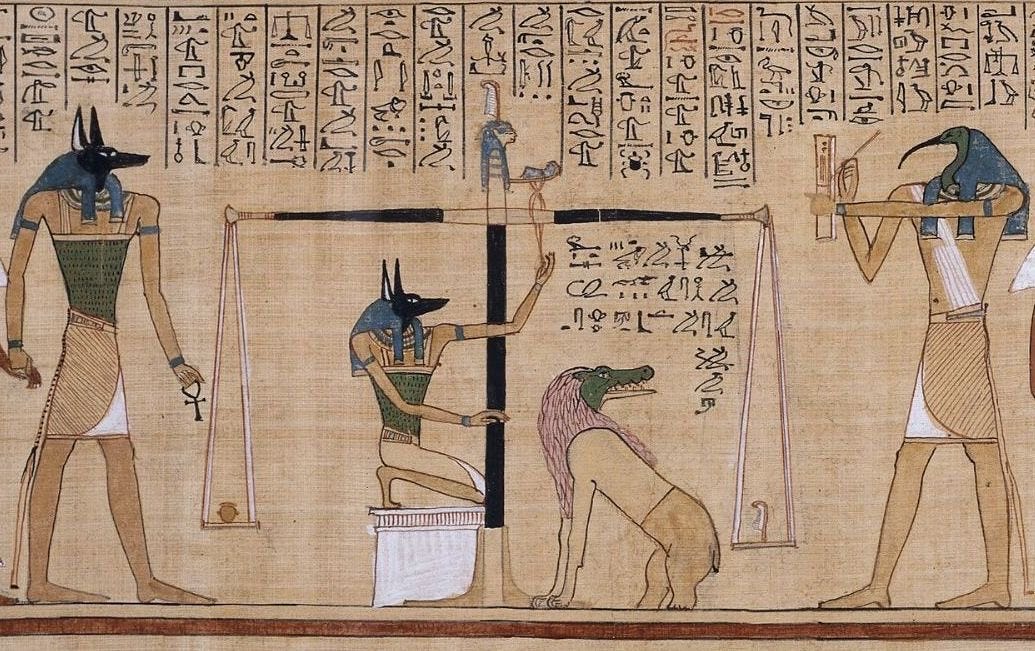
(Image: the weighing of the soul - see)

Again in this imagery the correlation between the cycle of the Sun God on his solar barge, through the gut of night is evident. Jeremy Nadler suggests that the Duat was seen as being contained within Nut, the goddess of the night. She was visualised as a naked woman whose skin was speckled with the glitter of stars. In representations of her, she can be seen stretching her body in a graceful arc over the Earth.
One of the Duat’s most well-known locations is The Hall of Truth, named after the goddess of truth and justice, Maat. Here, dog-headed Anubis would weigh the measure of each soul against the feather of Maat, while the god Thoth recorded each result. Here the judgement was made upon the virtue of each soul, for only those worthy would be reborn.
Like many cosmological myths, there’s also a link with dreaming, inferred by the Duat’s association with night. I’ve always had a sense that what we dream is something that exists (especially those reoccurring dream-spaces that populate the mind) even if it be purely encapsulated within immaterial space (eg; the realm of thought). I don’t know about you, but I have distinct dream places that form a backdrop to many of my dreams. There are cities that are melded concoctions of places where I’ve lived, most notably Cork and Edinburgh. There are also zones consisting of numerous passages, corridors and stairwells, some of them immeasurably ancient, others that are more recent. Many dreams involve me just wandering through them. I’m alone, but have no fear.
I sometimes wonder about this correlation, for it was a relationship that Burroughs explored, and something that he was obviously fascinated by too (as many of us are). It is the sense of a dream-state into which we move upon death. A place where strange entities wait for us, a place that is both wondrous and frightening. The entities that await are perhaps manifestations of ourselves (but belonging to the collective conscious) that are to be faced. They are either to be overcome, integrated or accepted: for these manifestations are the accrued spite, malice or regret that we’ve harboured over our decades. Perhaps the point of this dream-state Duat is consolidation, facing inner demons, facing the parts of ourselves we’d rather not face in life. Perhaps that is what this Duat stage of afterlife is. The gods of the Duat rise as archetypal forces, bearing the faces of gods, even though they may wear another guise. They are the manifestations of our emotions and our actions. Other versions of the Underworld incorporate similar ideas.
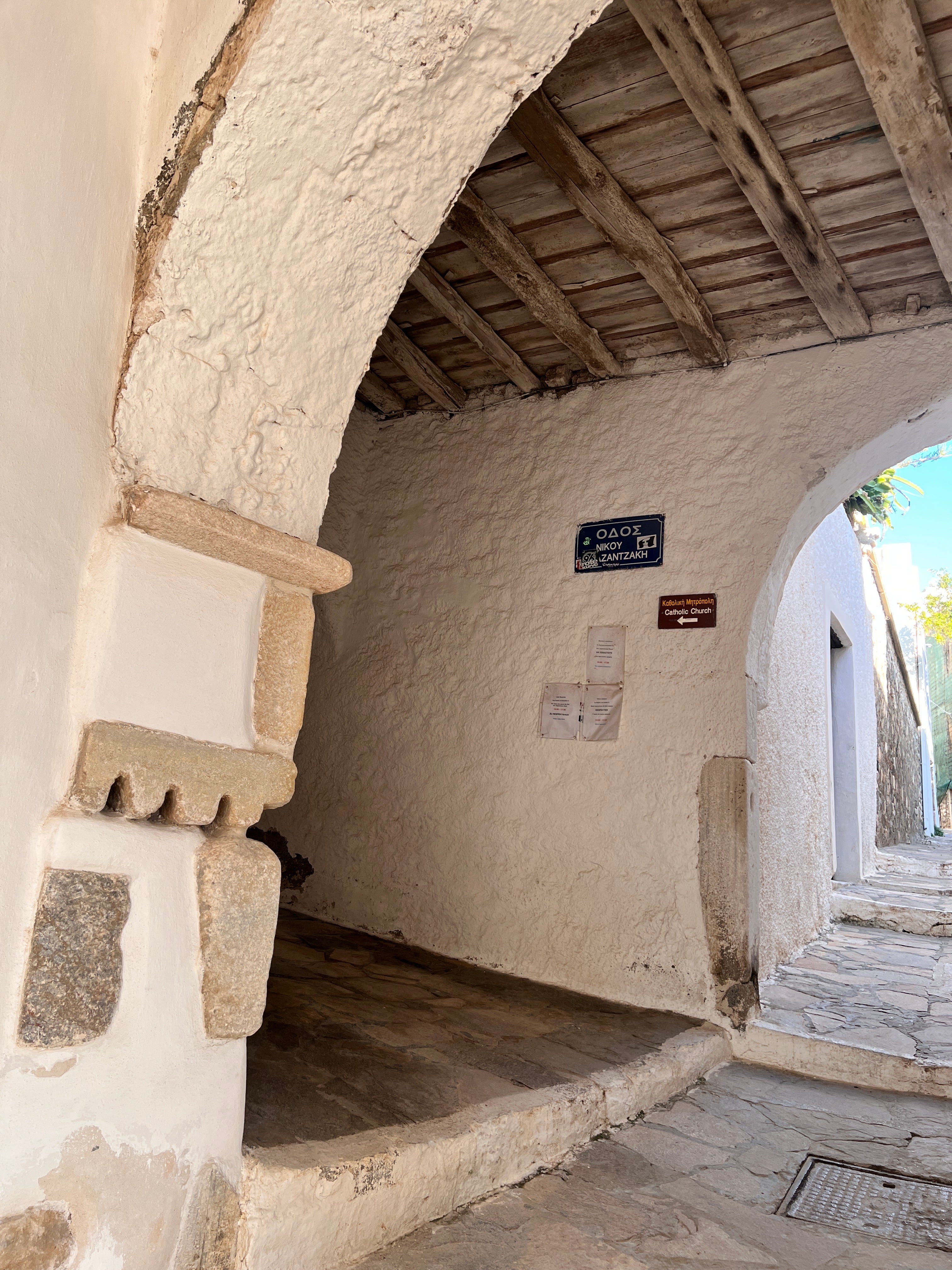
Recently I have spent some time in the Grecian Cyclades islands (as I write this I’m still there). The architecture of each island’s Choras (pronounced hora) is ancient. Many are built upon the bones of their pagan predecessors, with the scattered remnants of ancient temples incorporated into the very fabric of their structure. Chora simply means village and they are fundamentally maze-like in form. The design is both intentional and organic, and there are a number of practical reasons it came about; one being that the narrow streets provide shelter from the winds that can hound the islands, blowing ceaselessly for day after day, as well as providing shade from the glaring sun. Another was as a defence against pirates who harried the islands in the 15th to 17th centuries. The Labyrinthine nature of their passages can be very disorientating, giving inhabitants a chance to escape, or fight back guerrilla style.
Naxos Chora is a prime example of the reuse of objects from the past, and the labyrinthine nature of the town. Its extensive network of passages can feel otherworldly and liminal, especially out of tourist season. Its great age is evidenced in its structure, where the past is embedded in the physicality of the form. These are like symbolic manifestations for our inner life, in which the tunnels of our mind contain fragments of older patterns of thinking, modes of behaviour etc. In effect the Chora becomes something personal and, if we allow it, feeds into thoughts and feelings about the nature of the labyrinth and afterlife. The whole construct takes on a spell-like quality, otherworldly and meaningful. Wandering the passages, I’m always reminded of my wandering dreams, of Burroughs and the Duat.
*I was also big into horror fiction too - but it was also cosy, in that its form was standard and straightforward. They lacked the experimental cut-up-ness of Burroughs’s technique. The point of which was to mess with the convention of normal ‘cosy’ thinking in order to make us actually think.