

Solid Time
Notes from a Stone Carver's Sketchbook

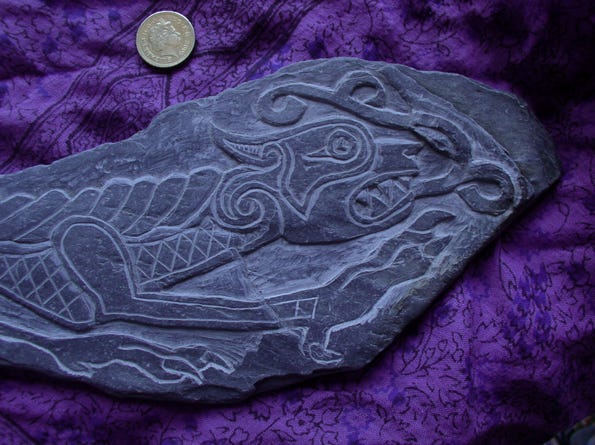
According to science, the earth formed from the stabilisation of chaotic elements, gaseous ingredients coalesced and chaos was ordered into cohesion, solidity. A colossal fusion reactor burned for millions of years and as the heat went out of it the Earth’s crust was formed.
Stone strata is indicative of numerous aeons and shifts in the geology of the planet. This cooling and solidifying wasn’t a seamless transition but prone to shifts; cataclysmic eruptions from below the eggshell surface. Earthquakes, tectonic shifts, the rising and falling of great oceans. The multitudes of different forms of rock were woven like fabric, layers cracked and skewed, were buried or rose. As sections of the surface shifted, the earth crumpled upward to form mountains. Limestone towered into the sky, which was once ocean floor, teaming with life, whose remains can still be seen along some mountain trails.
These different types of rock are moments frozen in time. They are solid time. Take for example the rich, red sandstone beds that lie as a bedrock across much of southern Scotland. Millions of years ago they were the sands of some huge desert bordering some huge ocean. Dinosaur footprints, fossilised for posterity, have been found at quarries such as Corncockle and Lochabriggs – specimens can be found in Dumfries Museum, housed in dusty, ill-lit casings. But the prints remain, as they have done for millennia upon millennia, their great age challenging the Christian worldview, with its 6,000 years.
Each beach affords nuances of geology. Each stone type its variations, gradations. Take slate, which is amongst the types that I carve and collect from lochs and beaches. Varying in hues, some come with iron pyrite cubes embedded in them, some are soft, some soft as mudstone, some dense, hard and brittle, and others are too hard to carve.
To fashion it, you need to know stone. You need to forget tradition and yet be inspired by it. You need a good eye and a stirring in the heart. An obsessive need, a passion and a love of history. Because to know the stone, to allow it to yield as you desire, you need a stock reference of images in your mind’s eye.
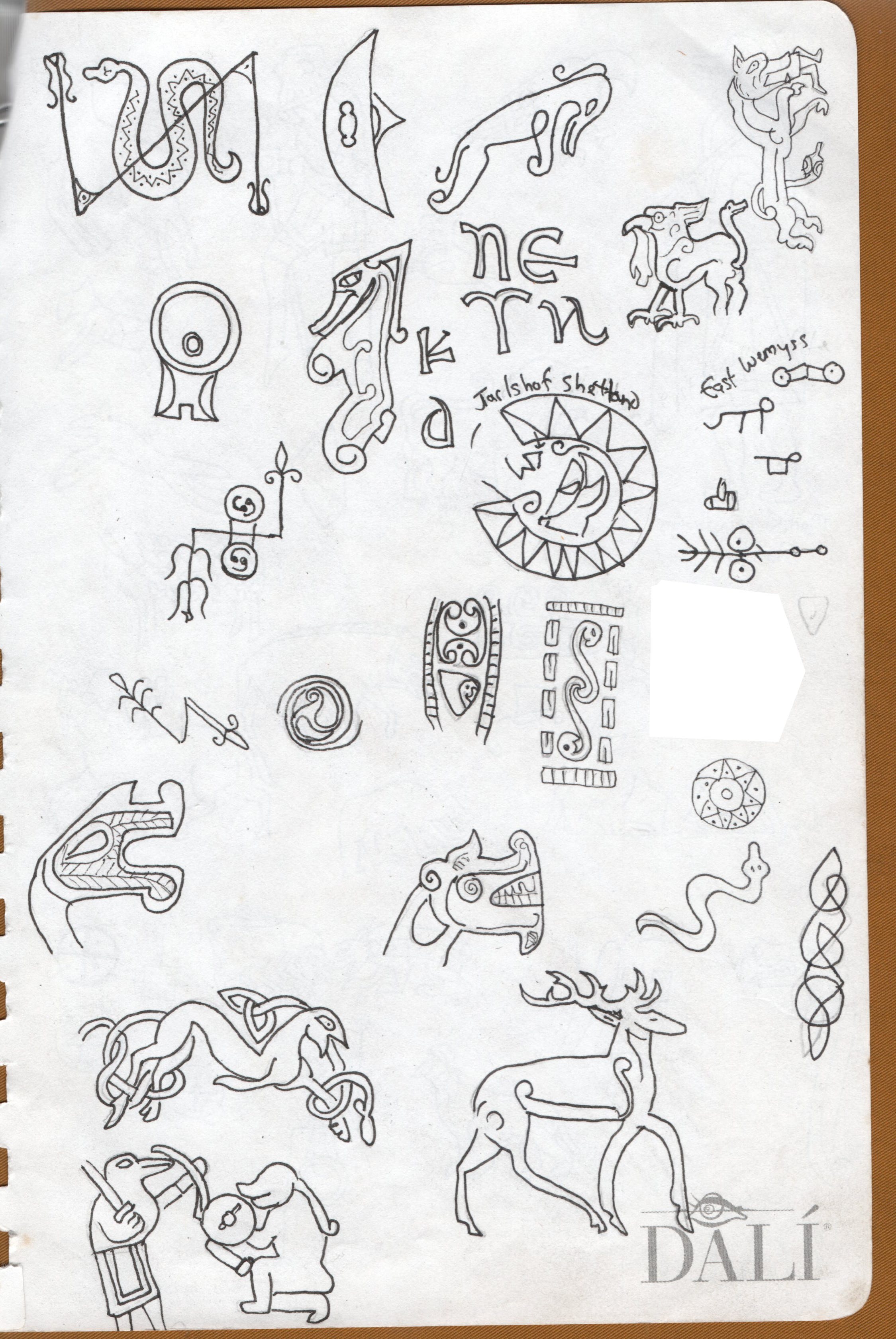
I bolstered my reference with pictures gleaned from archives and libraries: places where I spent my winters ploughing through book after book, sketchbook open.
I can’t stress how important it is to draw the designs of the past. The designs of your culture and those neighbouring to begin with. Everything has an epicentre and thus, like our species origins in Africa; we radiate outward. This is the same process we apply to drawing and to carving. We start at a fixed point and radiate out. Eventually we move back to source.
You need to fill sketchbooks with these designs. Study them and learn about the people who made them. How did they live? What tools did they use? Why did they make these impressions? What did stone mean to them?
Collecting these motifs can become a passion in itself, they are ammunition in your arsenal of art. Indeed, you should approach the stone like a warrior with a grounded philosophy. The process of collecting, of refining, of learning; these are processes that stir whirlwinds of inspiration, which we must learn to temper and train to use; not allowing these passions to range across our inner landscape like tornadoes, destroying all in their path.
I like to sit low and I like to hold the stone close. I’ve always worked this way, and being left-handed, I work with the stone perched on my left knee. I prefer to work outside too, in the fresh air. Holding the stone is important. You should feel it against your skin, cold in the winter months, warm in the summer. You must be able to grip it using your other hand like a vice.
First you must learn a traditional technique. Some prefer hammer and chisel. I began with screw drivers and then electrical screwdrivers, that I kept incredibly sharp. The technique was self taught. It just seemed right and came naturally to me. The stone I used at the time, I found on a beach not far from where I was living. It was smooth and grey, and worked very nicely. With these tiny screwdrivers, I gouged intricate knots and patterns. This is how I learned my trade. The lessons of trial and error in the pre-internet society.
Because we live in an age of easy answers I do not (yet) post videos of my technique. Perhaps one day I will, but for the moment, suffice to say that I use a mix of modern and traditional tools. When I tell people that pain is a great teacher, I mean it. You learn your art by the mistakes you litter the world with on the way. The process is on going. It needs to be. Those who are self-satisfied and content with their work are no longer progressing or improving. Everything you make will be imperfect in some way. You should never be wholly content with it. That doesn’t mean you should forgo pride; be proud of your work, but understand it’s a long road. We can all improve the foundations we are building. Even after decades, there is much room for improvement in my work.
Only when you’ve stuck your fingers with prods of metal will you begin to learn a number of things. The art is not just about the object. It is the artist, it is the context.
If you begin your craft by buying the best tools and splashing out hundreds on equipment then you’ve missed the point. Begin small, simple, use what you have and adapt it. I used milliput that I moulded to fit the shape of my hand, in order to make handles for my screwdrivers. This gave me more push. Eventually a French craftsman, who used to carve metal plates (before laser cutting made his work obsolete), gave me a set of engraving tools. I imagine the tips were tungsten. They were a step up and I used these for many years.

Nowadays I use a selection of rotaries and various bits. It is still very lo-fi. It is hands on. The difference is that the rotary allows me to get into harder stone and alleviates some of the tension of my previous technique (it still gives the arm grief after decades carving).*
These days I also carve designs in a spontaneous way. I allow the stone’s shape to guide me, backed up with all the designs and ideas crammed into this skull of mine. When carving I am wholly focused on each piece. Some days, if the feeling isn’t there, it’s best not to bother. Better to do something else, because the results will be poorer than when you feel it– even if no one else might notice, you will.
I’ve never really questioned this calling to the medium of stone. I began when I was young, and it just seemed to sit right. Stone feels familiar, and I can tell these days which pebbles on a beach are suitable for my technique and which will cause me no end of grief. It’s a sense earned after decades, one that doesn’t rely solely on sight and touch.
In mythic time stone is the bone of the world. I find the metaphor deeply poetic and it’s nice to imagine that what I carve are the skeletal remains of a giant – Ymir’s bones.
*Learning to manage pain is part of the process. Knowing when to carve and not is something learned with experience. You can’t get such knowledge from a You Tube video.


Your words really resonated with me. I am called to old crafts and started with broom making, then drums, and leather work… but I’m really called to carving. I feel like there’s work in my hands but the medium hasn’t found me. I agree what you say about not making if you don’t feel it. So very true. Your carvings tell the story words cannot. Beautiful.
Your work is amazing.