

The Gods We Cannot Name
The Case for a Celtic Pantheon

Pantheon: all the gods and goddess of a people; pan = all, Theion = holy.
The gods and goddesses of the Celts can seem like shadowy figures viewed through the dark glass of history. Some details of their natures can be teased from literary records – some are embedded in the Medieval lore which turned them into historical characters, faeries or monsters. But perhaps some of the rawest data spills from the quills of writers of the Classical period, who offer us hints at the form Celtic beliefs took. These scholars reveal that the Celts worshipped the immanence of nature, and that they possessed a multitude of local deities, with several that were common amongst them.
The Classical musings are the works of Greek and Roman authors examining a foreign culture. But they are outside it, observing. We have to take their references with a pinch of salt. They wrote for their own reasons, which were often ‘anti-barbarian’ in nature. Lucan’s description of a druidic grove in Gaul springs to mind here: it is a dark and evil place, strewn with entrails and reeking of rot. The imagery that he conjured was intended for a Roman market, and Lucan was seeking to evoke a particular atmosphere. The truth of his words are debatable and, for a start, he’d never been to Gaul.
While we know that the Celts worshipped at wells and in sacred groves, the view that they had no temples (or honoured deities in human-form) has been made defunct by archaeological finds. Embedded in the earth are the foundations of their ancient religious practice. Examples of complex sanctuaries come from such sites as Roquepertuse Sanctuary and Entremont Oppidum. These sacred spaces included shrines and temples. They also date from before the Roman invasion – after which temples in the Roman style appeared throughout conquered territory. Although the Celtic style known as La Tene tends toward wonderfully abstract forms, recognisable faces and figures do exist (and are even found in the Hallstatt period which preceded it). One of the most iconic of Celtic finds is the Gundestrup Cauldron – dated to between 300-200 BC. This mighty artefact contains silver repoussé worked panels depicting (what are likely) the major gods and goddesses of the Celts.
When I approached the research for my book, Gods & Goddesses of the Celtic Realms, I was inspired by Garrett Olmsted’s book, The Gods of the Celts & Indo-Europeans. He makes the point that the Celts likely possessed a pretty cohesive narrative built around a core pantheon of deities. Being an Indo-European civilisation, he asks if their deities would have been so very different to those of their contemporaries? Given the many similarities in Indo-European beliefs this makes sense.*
Poetry was the lifeblood of the Celtic peoples. Not only did their esteemed druidic class study the literary arts, so too there existed a hierarchy of poetic grades. Bards were disciplined in many forms of verse and metre – poetry was so important that the bardic class persevered throughout the medieval period.** Poets were honoured and even took fees from royal houses, embedding themselves in the courts of their chieftains. For a price they provided praise poetry; bolstering the egos of their warrior kings. They also knew the old stories, the histories of each peoples, their lineages, and lore. Each bard was a veritable library, and their faculties of memory were sharp. Another tact of the bardic mindset, evident in much of their literature, is the use of epithets and kennings. Literary devices, such as the art of simile, furnish the mundane with deeper meaning. This is the root of poetic endeavour – in origin it is ecstatic and inspired.
The gods are referred to indirectly, as care is taken not to offend the powers that be. They are ‘the god that guards my people,’ and watch over land and tribe. Such oblique references are intentionally deferential.
Language is complex and the way it changes is subtle but ever-evolving. Thus peoples who once shared a common tongue find their language mutates the further apart that they drift. Over time, what began as a proto Indo-European language became the multitude of languages that range across Europe and beyond. If we break down the Celtic languages into handy hold-alls we have Gallic, Goidelic and Brythonic. Just as language changed over time, so too the original ‘concepts’ of religion did too.
To illustrate this point let’s take one of the chief Irish deities, the Dagda (the Good God). He appears as both spectacle and sage whose comical nature is countered by his role as God of the Druids. He wanders the land with his huge club – a weapon so big it’s sometimes mounted on a wheel. One side is smooth and brings life, the other is rough and ushers in death. Amongst his magical items are a harp and a cauldron of rejuvenation.
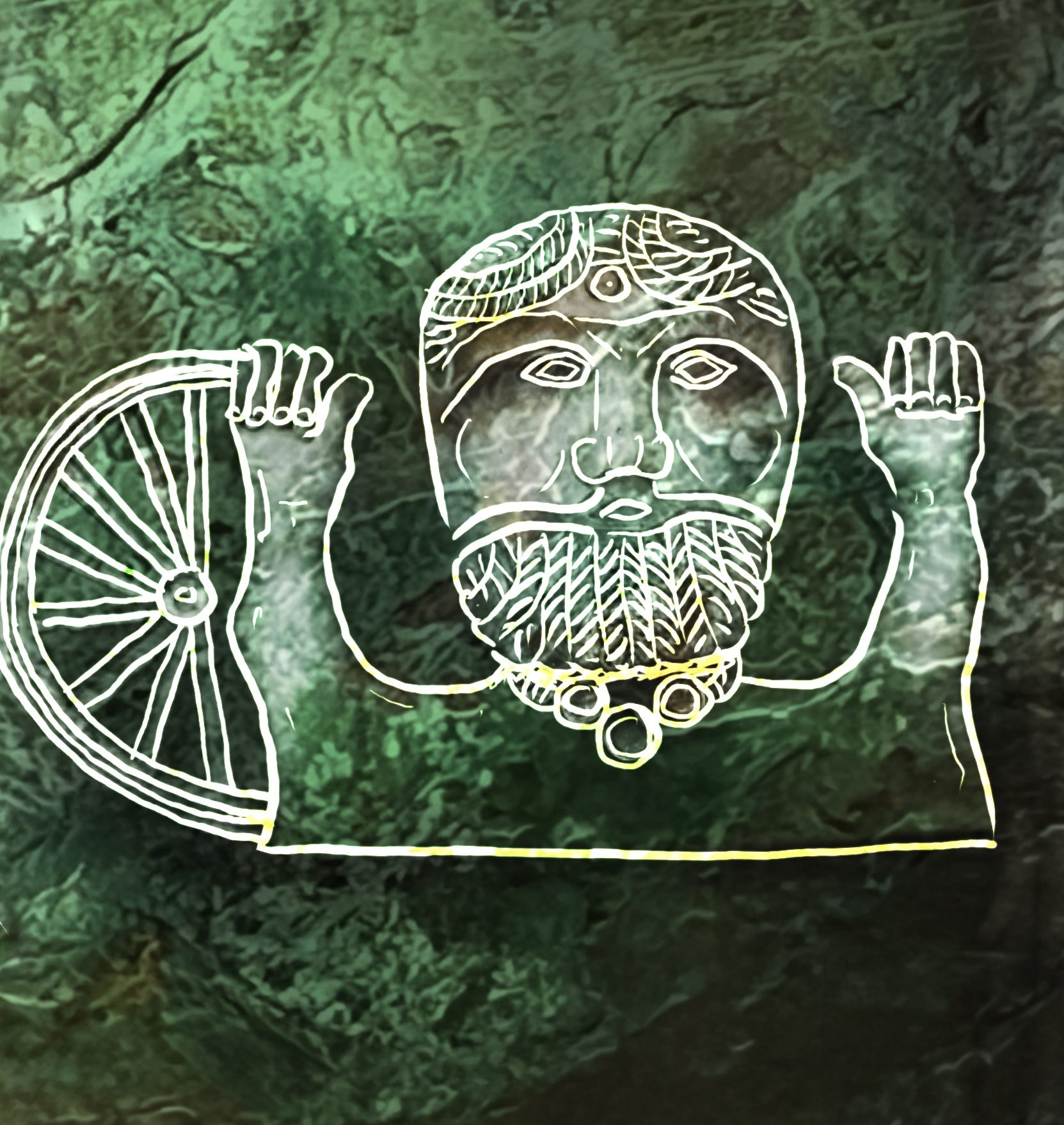
Throughout Gaul and Britain, the figure of Taranis appears as a Celtic Jupiter – so named by the Romans because this character appeared to be a version of their main sky god. It’s from the Romano-Celtic period, in those territories conquered by Rome, that much of the imagery of this deity comes. He his often portrayed carrying a great wheel and lightning bolt. His name means ‘Thunderer’ but some inscriptions also include the term Uxelli(sa)mos, which means “The Greatest”. He was honoured in carvings across Europe, and one from England names him Taranus. Another Gaulish deity is the hammer god, Sucellus (whose name means ‘Good Striker’). His imagery sits well beside those of Taranis and, intriguingly, we find very similar imagery to the Dagda. There is the huge mallet, and the pot/vessel. The Good Striker isn’t a proper name, just as Taranis and Dagda aren’t, they are epithets. The Dagda shares the Morrígan’s bed at Samhain, and so too Sucellus is paired with a female deity called Nantosuelta. Imagery associated with this Gallic goddess includes ravens or crows – birds with which the Morrígan is also associated.
Roman references to the main god of the Celts name this deity as equivalent to Dis Pater, their god of the Underworld – he is given the double-barrelled appellation of Taranis-Dispater. However, Sucellus is often accompanied by a dog, that sits patiently at his feet. Similarities between the Etruscan god Charun (the Greek, Charon), who is also a god of the Underworld, and appears with the multi-headed Cereberus, have been made by scholars. He also holds a hammer – and here we should briefly introduce a very familiar hammer-wielding god into the mix.
Both Thor and Taranis share the same etymological root. Like the Norse sky god who has mastery over the elements of the storm, Taranis clutches a lightning bolt.*** Like Thor, Dagda possesses a mighty appetite for food and drink. As one of the Tuatha De Danaan, his enemies are the monstrous Fomorians, just as Thor’s enemies are giants. And, as Thor grapples Jormungandr, imagery of Taranis sometimes depicts him trampling a serpent monster beneath his mount’s hooves (my forthcoming book, Dragons of the Deep, covers this dragon-slayer trope in much more detail).
Thus, in the Gallic speaking lands, we have Taranis and Sucellos appearing as different functions of the same deity. The Sky Father, and Underworld Lord – they are the same, and their names reflect poetic epithets depicting the nature of these differences. The same deity is traceable in Goidelic as Dagda – while the Old Welsh version is buried in Medieval lore; humanised and obscured, he may appear in the figure of Arawn, Lord of the Underworld. It could be that, originally, there was a single god of both Underworld and the Heavens who became two separate entities as time passed by. It’s also possible that people understood them to be the same deity, appearing under different epithets.


However, we must be cautious: such links might suggest regional variations and divergences that grew wider over time. But I feel that the more we examine the poetic meanings of the names of these deities, perhaps more epithets will emerge. The bewildering multitude of known Celtic deities may well consist of many such by-names for the same character. It’s an intriguing idea and I recommend Olmsted’s book (link below).
The continuation of the ‘oblique’ reference is traceable in faerie lore. In my researches over the past year it’s become evident that much of this lore bears earlier precedents. Where the Faeries were held in awe, they were both helpful and dangerous. People took pains not to mention them by name. They were the Good Neighbours, the Gudefolk, the Hidden or Huldenfolk – all deferential epithets for sure! But as downgraded deities or animist spirits, their lore remains, embedded in the world itself. Not buried, but latent beneath the surface.
Notes:
* This similarity is hinted at in the ease at which invading Romans conflated their gods with those of the peoples they conquered.
**Despite the change of religious accoutrements that swept the lands with the arrival of the Christ cult.
***If you’ve ever heard thunder in the Alps you’ll understand the reference to the wheel – for a good summer storm sounds like a huge wheel, rolling through the mountains.
References:
The Gods of the Celts & Indo-Europeans – Garrett Olmsted (LINK)
Pagan Celtic Britain – Anne Ross
Gods & Goddesses of the Celtic Realms – Dave Stone ;>
Dragons of the Deep – Dave Stone - out in July ‘26 ;>
Nicely worded. Your careful is research is evident in the coherence of the prose.