

Glycon... A Living God?
What is a God?

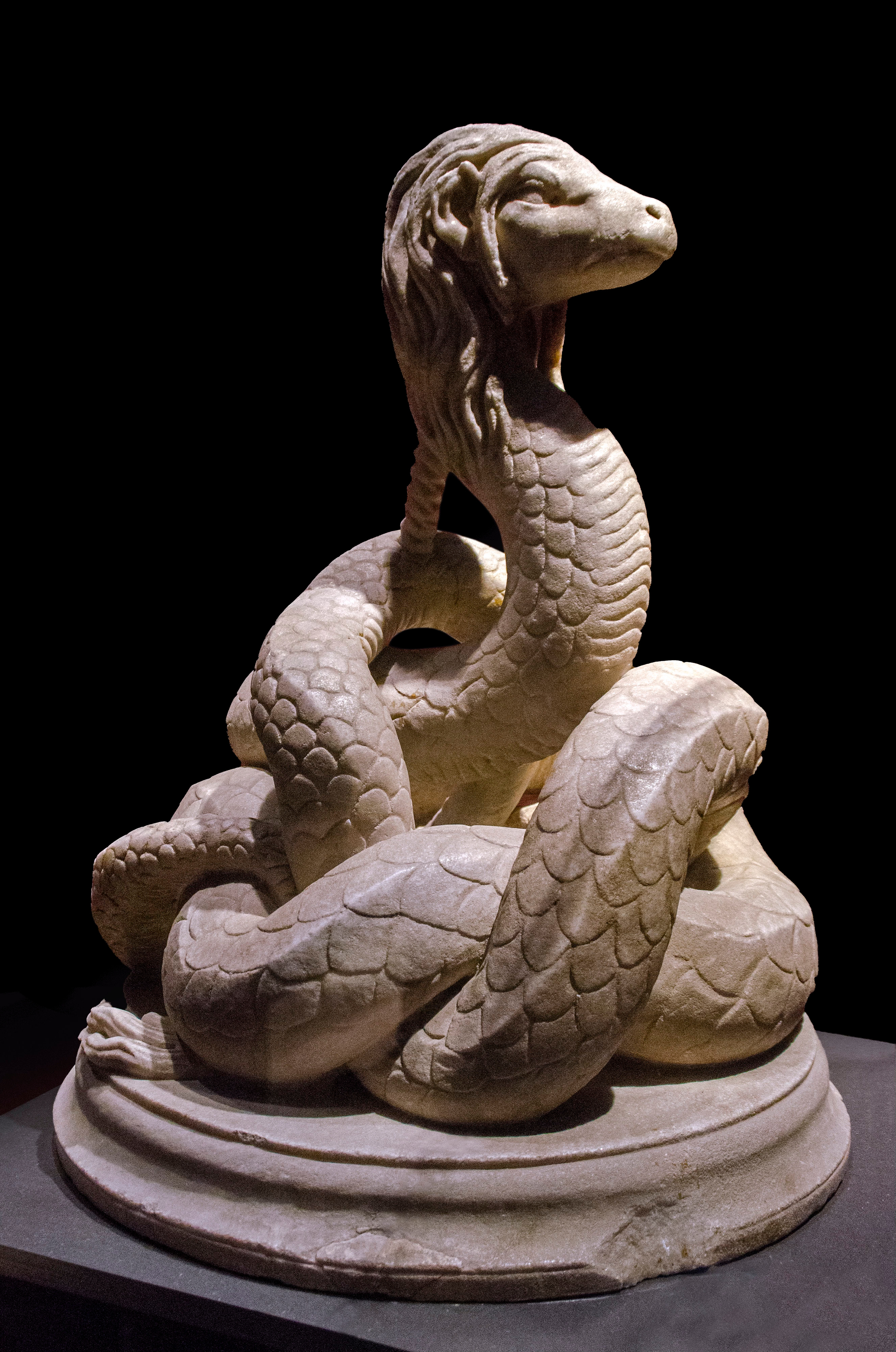
Late in the 2nd century CE, a priest named Aléxandros ho Abōnoteichítēs put a human mask on a large serpent and named it Glycon. Gaining some reputation as a healer and famed for doling out prophecies, the human-headed serpent was named as the child of Apollo, and people paid good money to receive its oracles. These took the form of metrical verses that responded to the question of each client. The cult grew in popularity and made Aléxandros very rich (in one year it’s said he handed out 80,000 of these verses, taking coin for each one). The fame of the cult spread a cross the land. Figures such as Marcus Aurelius sought Glycon’s wisdom before battle – though, in this case, Glycon’s suggestion that tossing two lions into a ravine to secure victory proved disastrous. Still the cult existed for 200 years or more. The scholar, Lucian, who documented the cult did so with much disdain. He viewed Aléxandros and his cult as a fraud. But Aléxandros was a multi-layered character.
Raised in the town of Abonoteichos, on the shores of the Black Sea in Asia Minor, he was a male prostitute before he became too old to continue such work. He entered into a romantic liaison with a magician who taught him pharmaceutical lore. Later, with another partner (possibly his lover) he travelled around Byzantium, paying their way as travelling magicians. Finally he returned to his hometown where he founded the cult of Glycon – claiming to have discovered the egg from which the god hatched beneath the temple of Asclepius.
Whatever the truth of Glycon, the fact remains that thousands of people believed and no doubt profited spiritually from their encounter with a living god.
When the Romans took their gods to the lands that they conquered, they matched them up with those native deities they found similar to their own, using double-barrelled names: Jupiter-Taranis, Apollo-Maponus, Sulis-Minerva. Two-thousand years before their empire, when competing tribes of Sumerians waged war upon neighbouring city-states the victors stole the effigies of the conquered people’s gods. These effigies were placed within their temples, appropriated or renamed. Even a cursory glance at Egyptian mythology reveals that gods replaced others.
But when someone worships the thunder god Vaya at a certain mountain and another tribe later replace it with their god, Indra, what is altered? What does the appropriation of another’s name mean to those that feel their god is still present? Monotheists would say the answer is simple: there’s only one god – and then tear each other asunder claiming the rights of their one god: its name, its favours and its creed.
Another element of deity worship is their anthropomorphising. This is a phase that most cultures went through at some point. Before this, there was more abstraction – deities were nebulous, unseen, unknowable. They were sinuous serpentine forms flowing through life. They were dragons.* The earliest human effigies are those of the so-called Venus figurines that date as far back as 35,000 years ago, with many dating from the Gravettian period (26-21,000 years ago).** These figures depict extremely stylised female bodies with exaggerated breasts and bellies, and often wearing some form of head-dress or mask. This stylised feminine form can be seen in many later cultures – the imagery from the Cycladic islands, for example, in which stylised female forms are rendered in marble with such artistry that still draw sighs of wonder from us today.
These are all images of veneration. They are nameless and the specifics of their veneration is very much obliterated by time. Yet when we see them (if we are thinking, feeling human beings with thoughts and ideas, not just automatons blinking at our phones) what feelings do they inspire? Whether it be the massive Egyptian sculptures of Isis or Osiris, the Classical Grecian marbles of Hermes and Aphrodite, Athena or Hera, or even the tiny Venus of Willendorf sealed within its glass cage in the museum of Vienna. What feelings surface, awe? A sense of being in the presence of something… an appreciation for the art of the age… or does something else surface? Is the effigy but a lump of clay, shaped by hands, or a stone worn by age, or is it something else?
So I ask, what is a god?
Perhaps Deity is many things. Animist spirits, energies intuitively experienced and felt. Or they could be closer to Carl Jung’s revelatory idea of the collective unconsciousness (see this post)? A space where archetypes are born as accumulations of symbolic intent projected in symbolic form.
Many polytheists out there experience contact with deity, feel in tune with the ‘otherness’ of the world. The use of ritual brings us into a certain state of mind. Sacred space is entered, the ‘other’ is invited in and ritual can accentuate the otherness of the space. We are trying to get into a certain mindset here, to break beyond the mundane and tune into something beyond us. If consciousness is the basis of everything and if, like physicists are beginning to suspect, forms of consciousness lurk in the background of everything, perhaps they are experienced through mediums such as the collective unconsciousness, or by tapping into the occult layer, through spiritual insight, trance or hallucinogens. Perhaps here we sense the presence of deity. Envisage them, hear them and take their advice.
These things can give us meaning to our daily lives and the struggle of getting through it. Personally, my practise is deeply personal. I believe everyone should have their own spiritual insights and shouldn’t be governed by doctrine held in manuals like some paint-by-number belief system. We should all question, go against, struggle with faith and reality. I don’t think that gods wait in books. Surely we can glean some information from texts, from those who have dedicated their lives in study, but I do not believe that any god left its words in a book.
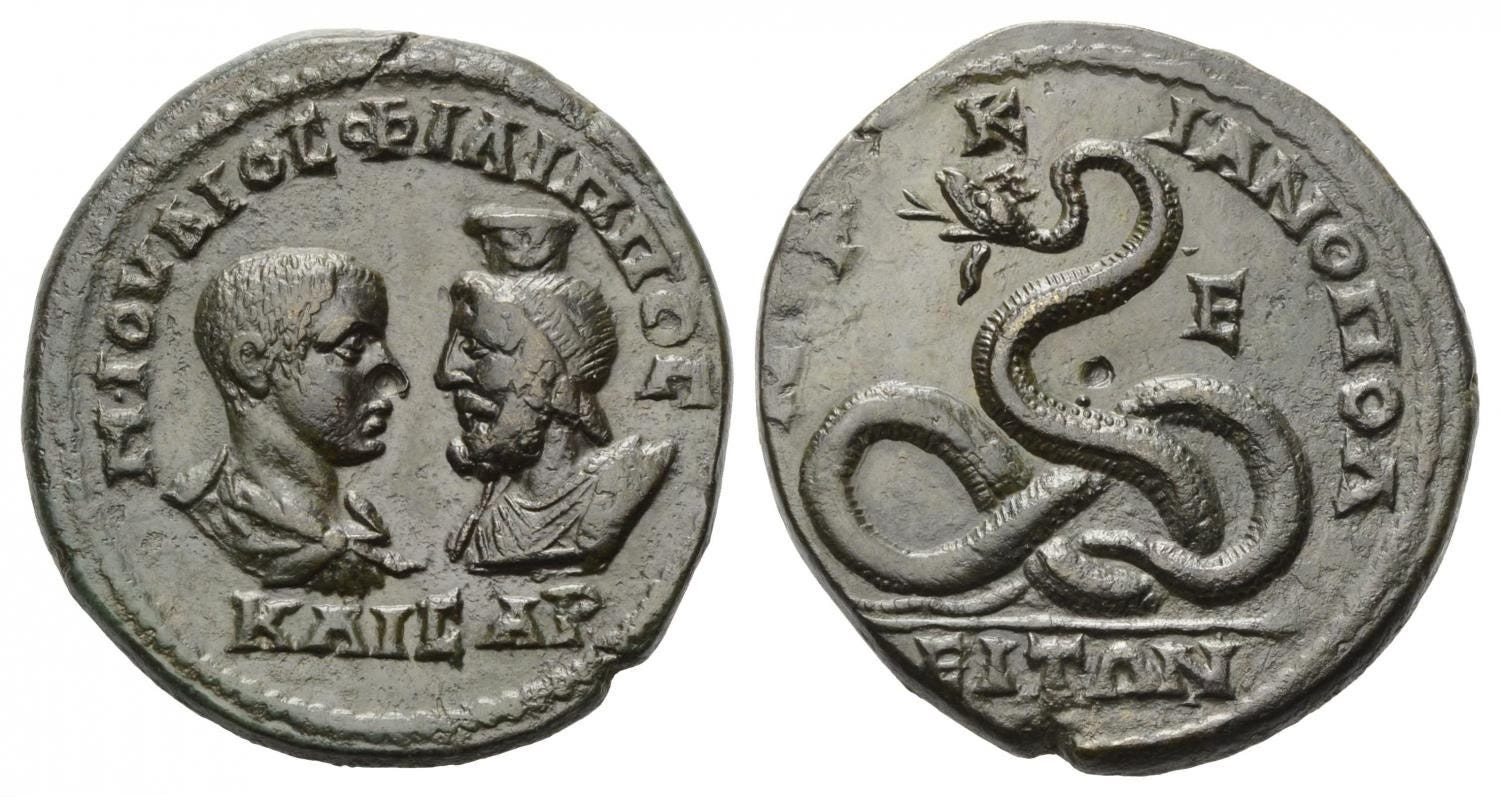
Whether or not the human-masked Glycon was fraud or a part of a genuine cult is debatable. Lucian ridiculed its founder as a charlatan. As a contemporary of Aléxandros they became sworn enemies, as Lucian ridiculed the oracle’s career. He even travelled to confront Aléxandros, a meeting that nearly wound up with Lucian being lynched by followers of Glycon. But Lucian had his own reasons for despising the cult, and anger propelled his criticism of Aléxandros’ doings. There were many other serpent sects around at the time, inspired by early systems of thought and falling under the umbrella of gnosticism, such as the Ophites. Glycon’s Cult spread across Asia Minor and outlived its founder, Aléxandros, by a century. The imagery of the giant serpent was an ancient concept, it had pedigree, lineage. Glycon was the son of Apollo, the god of prophecy. Many at the time would have been familiar with the myth that he slew the giant serpent, Python, at the shrine of Delphi. If Glycon was even a symbolic manifestation of such ideas, then he bore resonance with the people (fat-heads, as Lucian calls them). His followers believed, they obtained some benefit knowing he was there, visiting his shrine, seeking answers to the tumult of their lives – and in this respect doesn’t that tick the criteria of being a deity? a living god?
However, Glycon couldn’t save Aléxandros from the gangrene that infected his leg. He died aged seventy.
The whereabouts of Glycon are unknown.
Notes:
*This subject is explored in depth in Dragons of the Deep, coming in July 2026
**Of course, this number is probably unacceptable to those that believe the literal word of the Bible...and therefore 6,000 BC is as far back as they go. The rest is ‘filler.’
References:
Lucian – A.M. Harmon
What a timely excerpt. Everything is coloured by politics in my world lately, and this was a welcome distraction but even here, I find commentary on the state of today’s world. It seems like these is a cult building in the U.S., where a version of Religious-book cultists are trying to remake society in service to the “God” they see. No poetry involved, unfortunately. FYI I am now even more excited to read your upcoming book!
Great read, as usual, Dave. I also agree it’s every person’s spiritual duty to develop their own relationship with god/or gods. The story you tell of the founder of the cult would make an excellent screenplay 🤟